I was all set to be disappointed in Charleston. Everyone we spoke to said you have to go to Charleston. Everyone who has been to Charleston loves it. Charleston ranks repeatedly in all those magazine articles about the top ten places to live, the top ten places to retire to, the top ten cities on the East coast, the top ten historic cities….and on…and on…
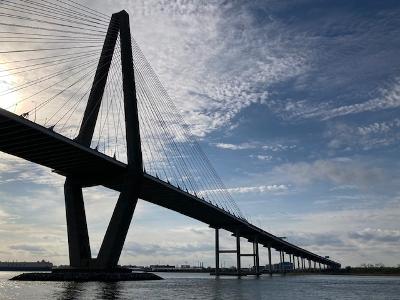
Ravenel Bridge linking downtown Charleston to Mount Pleasant.
Despite all that, we did decide to try out Charleston, even though we might be disappointed: it fit our trajectory, weather looked right for December, and everyone said…
So, now I am saying, if you go to South Carolina you have to go to Charleston! I’m a convert. And December is a great month to be there. November we stayed in Greenville, South Carolina. I have to say, go there too!

In Greenville, not the largest zoo we’ve been to, but nice. We could walk to it and could even hear the lions roar from our house.
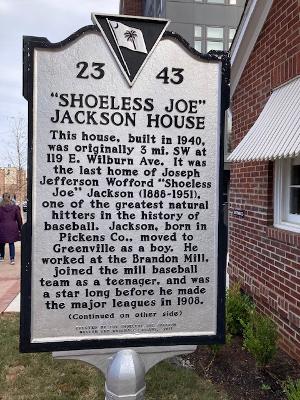
One of Greenville’s claims to fame. Besides the baseball memorabilia it still had some of Joe’s and his wife’s effects, even monogrammed towels in the kitchen.
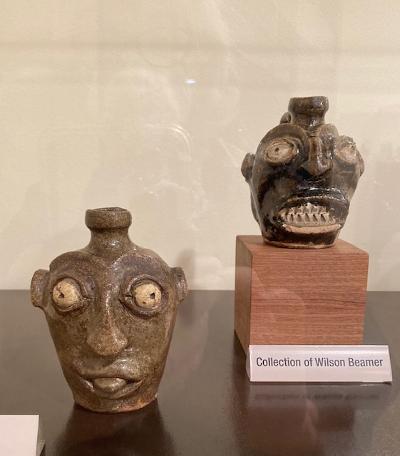
From the collection of face jugs at the Greenville art museum. Face jugs were created by slaves in the Carolinas and Georgia in the late 1800s. The distinctive style is similar to ritualistic objects of western Africa.
Even though we stayed two places in the same state, they were very different. For people like me, unfamiliar with the regional differences, it’s been interesting. There are the lowlands, basically the Atlantic coastal plain, and the uplands, or upcountry, which is the Piedmont and Blue Hills regions. According to history, the Upland thought the Lowcountry was stuck up, the Lowcountry thought the Upland was all backward hillbillies. During the beginnings of the Revolutionary War Lowcountry patriots fought Upland loyalists. During the Civil War this antagonism continued based primarily on their economic differences. The subsistence farmers of the Upland had few slaves; the Lowcountry plantation system was highly dependent on slave labor.
Being in Charleston is being surrounded by history. The city considers every building in the downtown area that is over 75 years old to be historic. Any repairs have to be in the same character as the original. It means there are many gorgeous old buildings in the downtown area. Does it also mean that the McDonalds on Spring Street since 1954 may be a historic site in 6 years?
Many of the old houses have privacy doors. These are doors that bring you on to an open porch where people would sit to cool off during the summer heat. Even though you might be able to see into the porch standing at just the right angle on the street, if the door was closed, come back another time. If the door was open, visitors were welcome.

Privacy door closed, come back another time.
There are lots of beautiful plantations to tour with historical displays, even reenactments, but a working one – the Charleston Tea Plantation – is the only tea-growing garden in North America. Who knew we grow tea! My friend Deb came to visit and this was top on our list to tour. It started in 1888 when a farmer in a nearby town imported tea plants from China. The farmer died in 1915 and the long-lived plants essentially grew wild there for 45 years until they were moved to the Charleston plantation. All the plants on the current plantation are descendants of those first ones. They use a custom-designed tractor to harvest just the top six inches of new growth from the plants, typically getting about 18 harvests per season. The tour included all the tea we could drink of course.

Tea plant blossom; they blossom in the fall which indicates
the end of the harvesting season
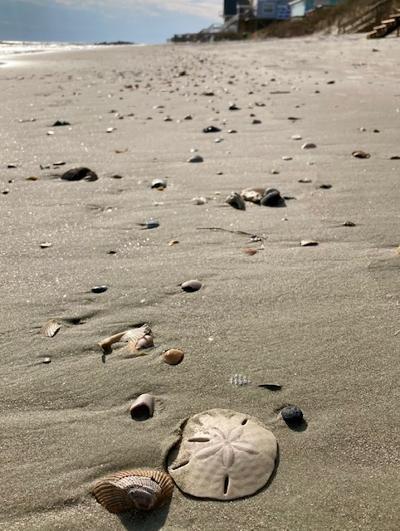
For John and me, part of the highlight of being in Charleston was being back at the ocean. A ten-minute drive brought us to Folly Beach, a great place to walk, find shells, see birds, and we even spotted dolphins a couple of times.
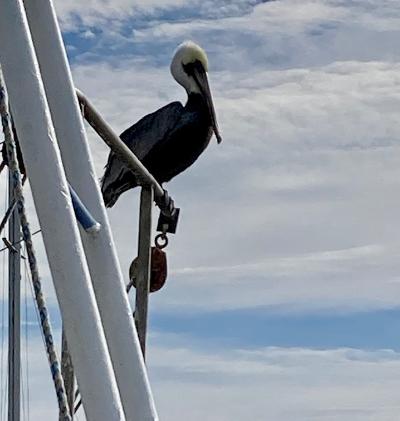
Brown Pelican, exciting for a Northerner
to see, but common here.
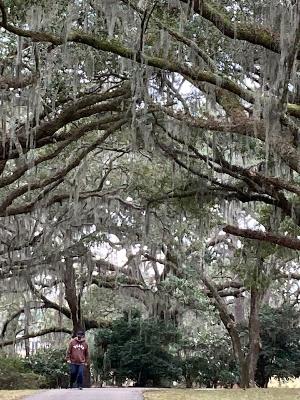
Spanish moss hanging from the trees.. It is neither Spanish nor is is a moss, but it is everywhere. In the bromeliad family and actually related to the pineapple.
We took a boat trip of the marsh for even more immersion in the coast and got good views of the Morris Island Lighthouse, built just after the Civil War ended. Even at the beach there’s history–after all, Fort Sumter is just across the water. Built for defense during the War of 1812 it was never used then but was the site of the first shot fired during the Civil War.
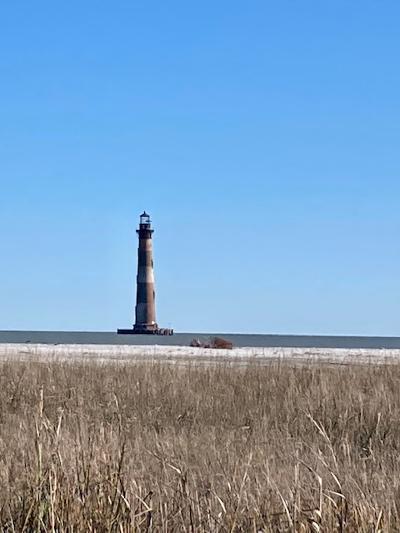
Morris Island Lighthouse
Another part of the charm was our favorite spot for a beer and nibbles, the Ellis Creek Fish Camp, conveniently under two miles from our house. So, I’m joining the chorus, you’ve got to go to Charleston and if you do, make sure to check out the Ellis Creek Fish Camp.

We’re beaching it now in Mary Ester, FL. Not as much history, not as much charm, but the whitest sand and most brilliant green-blue water you can imagine. More on that next time.

 Travel & Transportation
Leave a comment