“The City Different” – that’s how Santa Fe describes itself.
And there is much that is different about Santa Fe. But wherever we’ve been on this journey a few things stay the same: we try to stay in a house near a walking trail so we can easily do a daily walk no matter what else we do that day, and I scope out the libraries and spend time there reading magazines, finding events on the notice boards, and getting a feel for the community.
The Southside branch of the Santa Fe Library provided both the routine and the something different. In addition to the magazines and comfortable reading area, the kids’ art on display, and the events board, this branch had two things I’d not seen before. One was the “seed library”, shelves with seed packets set out so that people could take some to plant and leave extra seeds of their own. And the other was the short story kiosk. You select your reading time, the choices were 1 minute, 3 minutes or 5 minutes, and a short story of the appropriate length rolls out of the dispenser. I chose 3 minutes and got “The Bear Under the Bed”, a short story by Rolli, a well-known children’s author. It starts out, “Sometimes I can’t sleep. That’s because of the bear under the bed.”

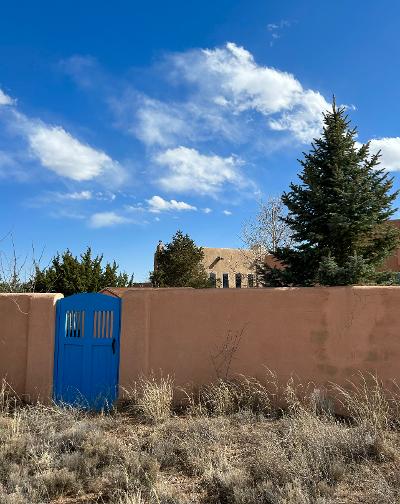
While we didn’t have bears under the bed, we did have lizards in the yard. And on our neighborhood walks. Once again, Santa Fe did something different than we’ve seen in any place we’ve been so far. The walking trails are not just in parks, along rivers, or in other public spaces; these trails were actually in large areas deliberately left between houses as the suburbs were built. So you walk along sometimes seeing nothing but trees, rocks, hills, gullies and sky, and then sometimes passing along someone’s backyard and admiring their windchimes, adobe wall or fence.
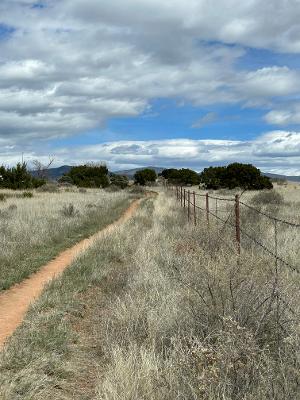
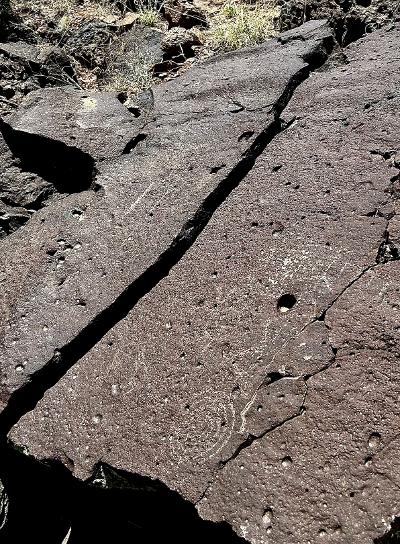
Besides walking the neighborhood, we try to find places to walk to see something different. One such place was the Cieneguilla Petroglyph Trails. The trail went along for a couple of relatively flat miles, a wide sand-bare trail with signposts every hundred yards or so pointing the very obvious way. Once the trail began to climb the mountain and became a just discernible track over rocks and tree roots, there were no more signposts. So we went the way we thought was right and did finally come across a few petroglyphs, hoping they were the real 700 year-old images and not something that present-day vandals scratched into the basalt rock with their car key. Heading back down the trail we felt good about our find until we heard the young couple who had passed us and gone beyond where we had stopped, yelling “look, a turtle!” and “wow, that one looks like an owl!” Clearly we lost the trail too soon.
But there was plenty of other art to be seen. Santa Fe is the 3rd largest art market in the United States. Canyon Road is the center of that, with over 100 galleries along a beautiful mile or so of adobe buildings with sculpture filled courtyards. My sister Kathy visited us and she and I explored these galleries, Most of that art was beyond my means but there are other more affordable venues in the city, especially the Sunday morning Artisans’ Market held in the same building as the Saturday morning Farmers’ Market in the Railyard.
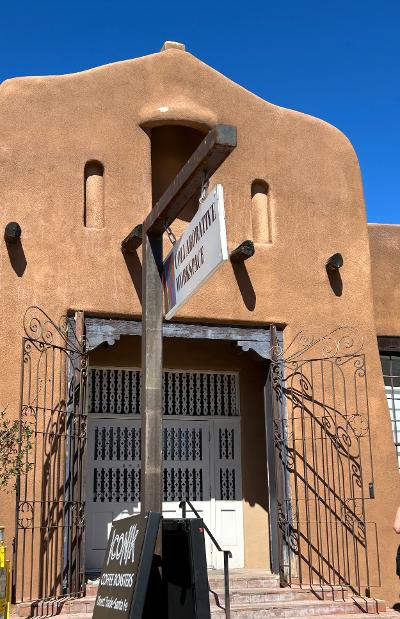
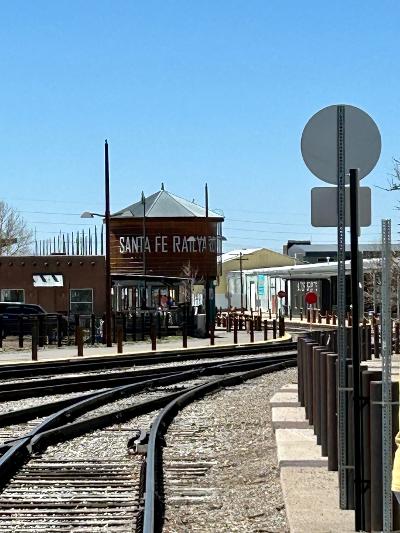
The Railyard is the one area in downtown “old” Santa Fe that doesn’t reflect the city’s near universal adoption of the pueblo style of architecture. In the early 1900s a movement led by archeologists and artists aimed to revive the city’s architectural roots, drawing on the Pueblo and Territorial architectural traditions with contoured adobe walls, flat roofs, vigas or beams. These buildings give Santa Fe its iconic look.
But the Railyard was deliberately rehabbed using the same materials and basic warehouse look as the original working railroad buildings had. The railroad came to Santa Fe in late 1800’s and was a center of commerce and tourism until it declined after WWII. In the late 1980s it was declared a blighted area and about 20 years later the city transformed it into a center of contemporary arts, museums, theater, restaurants, breweries, and living space. Two trains still use the tracks, a commuter train and a tourist expedition train. And one of the shops, La Lecheria, sells the tastiest New Mexico flavored craft ice creams!
Since Santa Fe we’ve moved on to what really is a City Different for us. We’re in Dolores, CO, a town with a population of 885. And the nearest town, 20 minutes away, has just over 8,000. This is by far the most remote and smallest town we have stayed in for more than a few days. But we have a riverside walking trail a block away and a surprisingly big library 3 blocks away, so not all will be different. Will tell you all about it next post.
Some random photos:
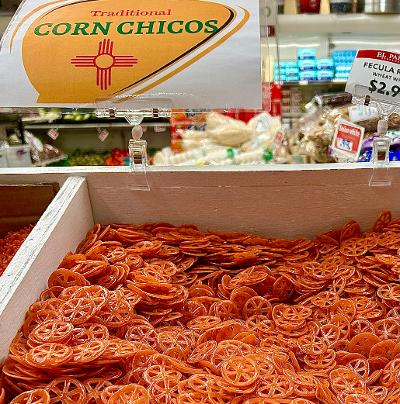
In every location I check out the ethnic markets. This was in the El Paisano Super Market. The wheels are a type of uncooked pasta.
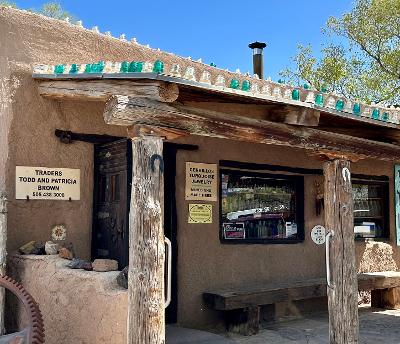
A Trading Post in the small town of Los Cerillos. It also had a petting zoo, Turquoise Mining Museum and scenic overlook of the hills that gave the town its name.
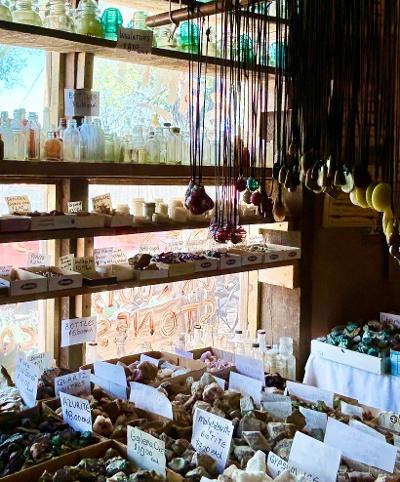
Some items inside the trading post. It also had cow skulls, a taxidermed buffalo head, pottery, etc….

Pecos National Historic Park, with ruins of the almost century old Pecos pueblo village and a 17th century mission. Here John descends into one of the kivas, a circular pit house used for religious purposes. The hole in the ground represented a connection to the Underworld, from which the Pueblo people believed they originated. Over 2000 people lived here at its largest point. The population dropped to about 300 people in the early 1800’s and they moved to consolidate with the nearby Jemez pueblo, abandoning this site.
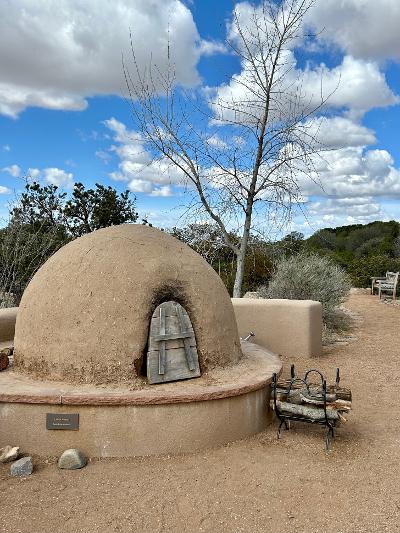
A horno oven. Wood is burnt inside it. Then the coals are raked, the bread is placed in the oven, the door sealed, and the bread cooks.
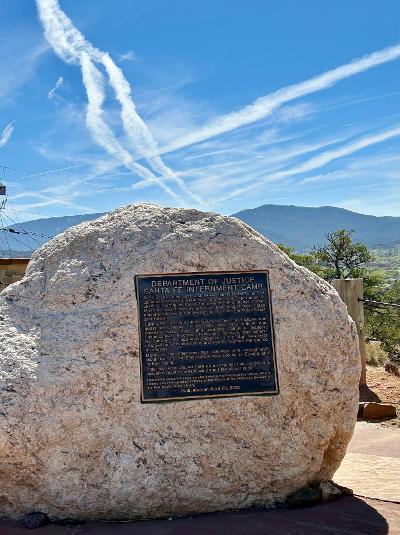
The Japanese Internment Camp Memorial. Santa Fe had one of America’s largest internment camps in the country during WWII; over 4500 Japanese men were imprisoned in it.
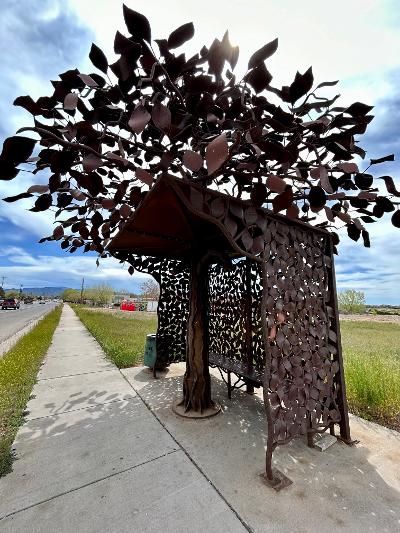
Santa Fe has some of the best bus stops I’ve seen. This one was one of my favorites.

At the Randall Davey Audubon Center. This historic building was the artist’s home and studio in the early 1900’s and was later gifted to the Audubon Society, with the surrounding 135 acres. Wild turkeys were doing their mating displays when we walked the surrounding trails.
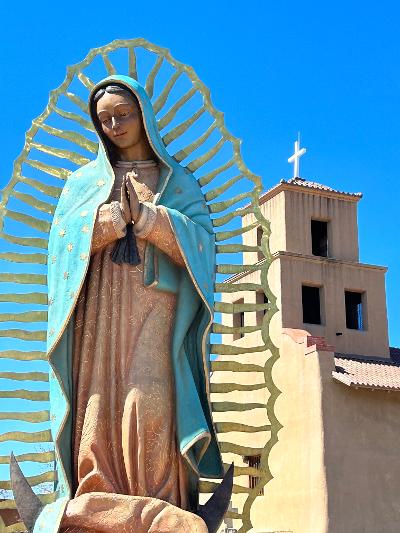
Our Lady of Guadalupe shrine in Santa Fe. In 1531 the Virgin Mary appeared to an indigenous Mexican, Juan Diego. She asked him to tell the bishop of her appearance. Juan Diego didn’t think the bishop would believe him and so didn’t. Later he was searching for a priest for his dying uncle and the Virgin Mary appeared and healed his uncle. To give Juan Diego proof of her appearance she filled his cloak with blooming roses in the middle of winter when roses don’t bloom. When Juan Diego showed the roses to the bishop an image of the Virgin Mary was imprinted on it. The bishop then believed Juan Diego, who was later made a saint. The Lady of Guadalupe is a strong symbol of faith in the Mexican Catholic Church.
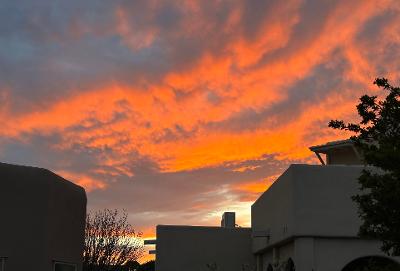
One of Santa Fe’s spectacular sunsets.

 Travel & Transportation
Leave a comment